This isn’t insider info… it’s obvious to anyone who pays even a little attention to the auction world.
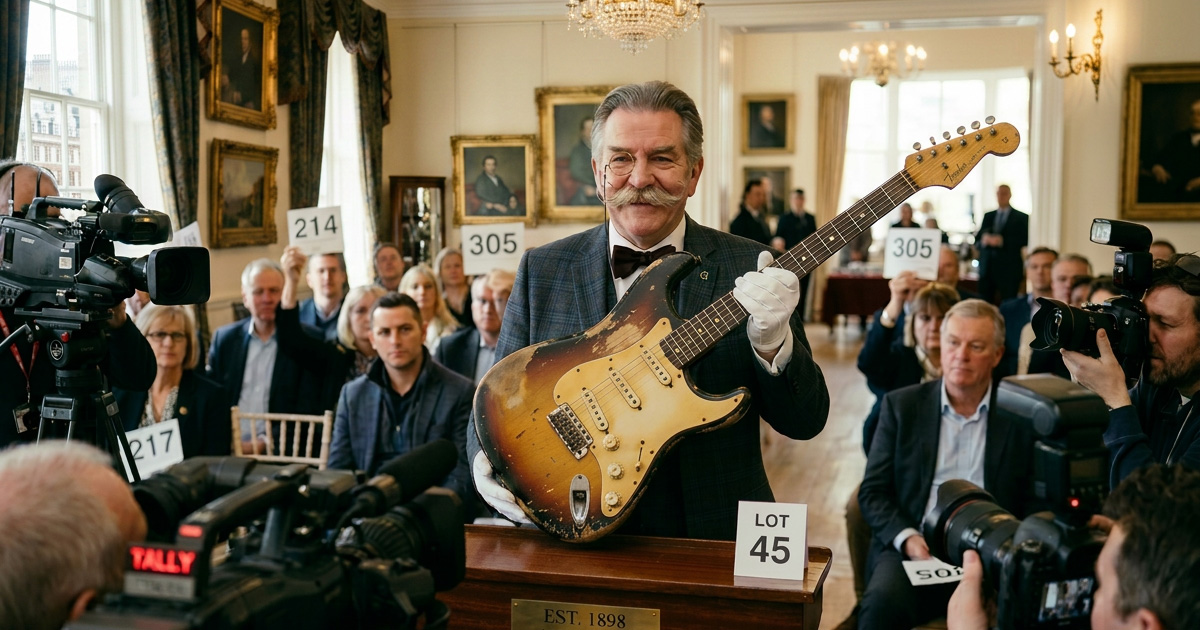
Many of the major auction houses tend to do the same thing when the cameras show up.
The white cotton gloves come out.
Principal representatives handle artifacts with theatrical reverence. The lighting goes up, the shot is composed, and the resulting footage looks exactly like every other shot you’ve ever seen of an auction-house handler holding a precious object.
When the press leaves, artifacts revert back to inventory. They are identified by serial numbers. Tracked with barcodes and scanners. Valued by pre-sale estimate, reserve, and revenue projection.
Numbers.
The dozens of staff that handle the objects as part of their narrowly defined role don’t have white cotton gloves assigned to them.
The warehouse staff don’t wear them. The photography studios don’t use them when shooting items for the catalogs. The catalogers don’t have any. The fulfillment department grabs artifacts with bare hands every day.
The white cotton gloves are the only essential component of a costume that projects a brand image for public consumption across mainstream media appearances and carefully constructed social posts. They go back in the drawer when the lights go down.
This is industry-wide. It’s not deception. It’s theater — reverence performed for an audience. The same put-on plays out for every type of pop culture object that passes through many auction houses during press appearances — from film props to screen-worn costumes to gear and instruments. And the longer I worked both outside of and inside that industry, the more clearly I saw something nobody wanted to say out loud: the entire reverence apparatus the major auction houses use was imported from fine art. It doesn’t fit artist owned and used rock and roll gear and instruments.
The white-glove apparatus came from fine art. Museums use cotton gloves because oil paint and canvas degrade with skin contact, and the moment of the object’s making is centuries past.
The framework deploys into film and television memorabilia marginally better — a hero prop or screen-worn costume is often crafted for a carefully orchestrated production process, every prop placed by a department, every costume designed for a character. These artifacts are often beautiful, valuable, culturally significant, and the museum-distance handling isn’t completely off-base for objects that emerged from a system designed to produce things to be shown sometimes up close on giant high resolution screens.
Artist owned and used music memorabilia is where the framework self-combusts and typically opposes everything the artist stood for.
An object that was actually on stage carries the artist’s identity, how they used it, and what they represent. The people who make music aren’t portraying characters; they are the characters. There’s no fourth wall. A live concert is not a passive experience you consume from a seat — well, it can be, but those aren’t the best ones. It’s something you’re inside, something where you can be heard and seen and felt and changed.
The manufactured white-cotton-glove media spectacle is at odds with all of it.
The marketing spectacle tries to shift the focus from the artist to the auction house, a failed attempt to siphon off cool with next level corporate cosplay.
Picture it: a man in an attention-grabbing suit and signature motif (pick one: bow tie, hipster moustache, a monocle, checked pattern fabric, loud Rolex, 18th century hat, silly socks…) carefully presenting a Stratocaster to a camera crew with white cotton gloves as the focal point.
The instrument lived its working life on stage, used and abused by an artist whose whole creative posture and persona was the opposite of that suit. Maybe he got into music because of corporations and suits… inspired to forge a path in the opposite direction of what that represents.
Like every horror villain, the empty suit always returns for one more scene.
A Nightmare on Wall Street.
The faux presentation doesn’t fit the object. Pretense misses the point.
This is the filler chapter, not the story.
Some are tone deaf in an industry built on sound.
The actual reverence is the research and work product that establishes what an artifact is, and the documentation that memorializes the history and context.
That should be the focus.
The first concert I ever attended was Beastie Boys and Run DMC on the Together Forever tour. 1987. I was fourteen years old.
One of two on-stage turntable cases from that tour is in this auction:
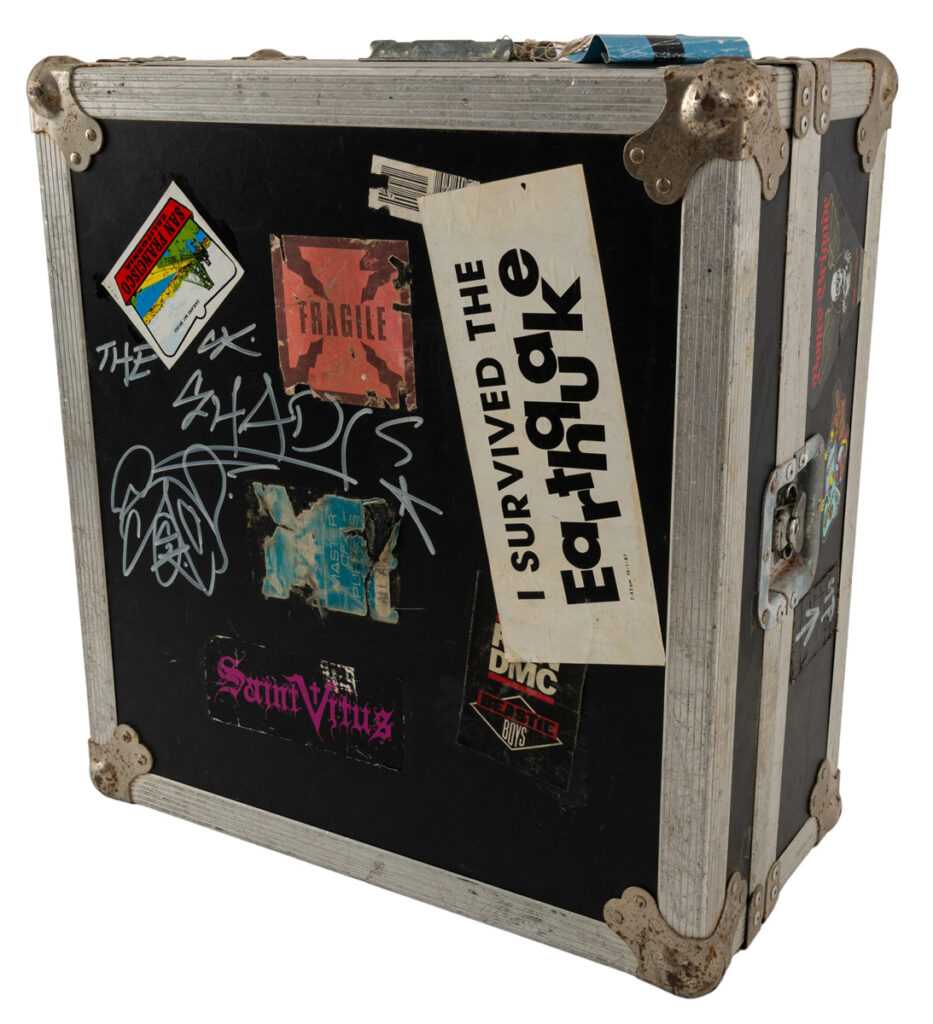
Thirty-nine years between the moment I was in that audience and the moment the case is about to find a new caretaker.
Moments matter.
It was on stage that night. After that tour, it still lived with the band’s posse, then lived through chapters I can’t reconstruct.
The case isn’t a symbol of that night. It was AT that night. It was a witness.
It had other moments… Soul Train, the Joan Rivers Show… everywhere the Beastie Boys performed in that era, the case was there as well.
But some parts of the story are lost to time. It has a bullet hole. As far as I could find, there are no witnesses to that chapter of its life. At least none that have spoken up.
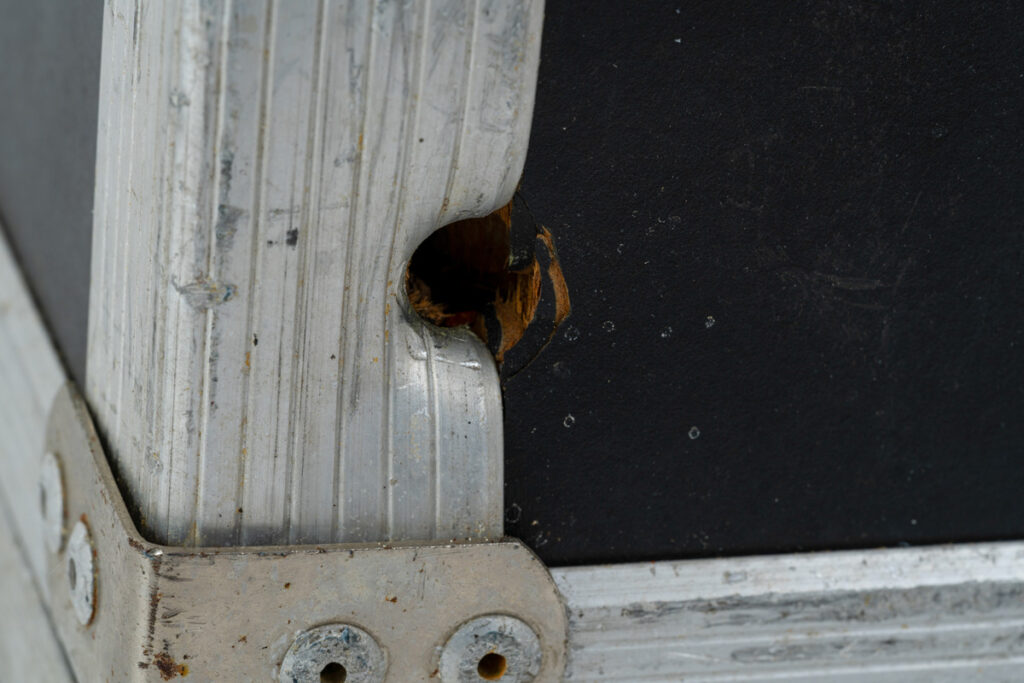
Nostalgia Bandit exists to try to capture and document as much of the story as possible before it’s all lost to time. But the best stories have a touch of mystery.
The artifacts that survive a live music moment are a different kind of object than a film prop. A film prop is the carefully-made instrument of a production — placed, lit, and shot by craftspeople doing meticulous work. There are multiples. Sometimes multiples of multiples and which one was actually used — when, how, who touched it — is often unknown outside of direct screen-matching.
A music artifact is a witness — something that was on stage, in real time, while a live audience was part of the moment.
The Beastie Boys turntable case from that night. The synthesizer that was in the room when the album that scored a chapter of your life was recorded. The microphone that picked up the vocal take that became the song you played a thousand times, singing along in your car. The drum kit that was being played when the audience around you became, for a few minutes, a single thing.
These objects were *part of* the moment. Not symbols of it. Not commemorations. Part of it. They participated in the same way the audience participated. They were in the room.
When you own one of these artifacts, you’re not preserving a piece of cultural production. You are inheriting a witness. You are taking custody of something that was actually there.
There’s a moment that happens at memorabilia exhibitions that captures the cultural confusion. Someone wanders in from a normal day at the mall or a tourist district. They see a display case with an artifact in it — a guitar, a costume, a handwritten lyric sheet. They look at it for a moment. Then they turn to the staff member nearby and ask, with genuine uncertainty:
“This is… a replica?”
They’ve been culturally trained that authentic artifacts are behind glass at the Smithsonian or the Rock and Roll Hall of Fame. The idea that the real object — the thing that was actually there — could be in a “normal” environment and something an ordinary person can obtain doesn’t compute. They assume what they’re seeing must be a representation, because in their mental model, the real thing is unreachable by definition.
That’s what the cotton-glove apparatus produces. Not respect for the artifact. Estrangement from it. A cultural framework where every day people outside of that bubble assume the real things are not for them.
I came to this work through years of editorial publications — the Original Prop Blog (2007–2019) for movie prop collecting and Rock Subculture Journal (2012–2019) for concert photojournalism — then served as COO and Executive Director of Julien’s Auctions. The fine-art-derived reverence framework was always lossy when applied to music. The thing that makes music artifacts what they are doesn’t survive the translation.
Nostalgia Bandit is what happens when someone with that vantage decides the framework needs to be different.
The bandit framing matters. Most categories of high-value collecting are gatekept. Music memorabilia at the level Nostalgia Bandit traffics in is not yet gatekept that way — the category is at ground zero. Most people don’t know it exists. Most people who would care if they knew haven’t been told.
The bandit framing is a counter-claim. These artifacts shouldn’t have been gatekept in the first place. The people who lived the music are the right caretakers — alongside the institutions and serious collectors who treat these objects with the seriousness they deserve. Anyone willing to take the responsibility seriously can be part of the next chapter.
When you take custody of one of these artifacts, you’re not preserving it behind glass. You’re not freezing it in time. You’re continuing its story. You’ll live with it. You’ll show it to friends. You’ll let it sit in your home or studio or office as a daily presence. You’ll talk about the show or the album or the era it came from. Eventually, decades from now, you’ll pass it on, and the next person will be the chapter after that.
Cotton gloves don’t matter to this. The Letter of Provenance does. Knowing what the artifact is, where it’s been, what it participated in — that’s the actual reverence. The pageantry was always pretending to be reverence. The work is what reverence actually looks like.
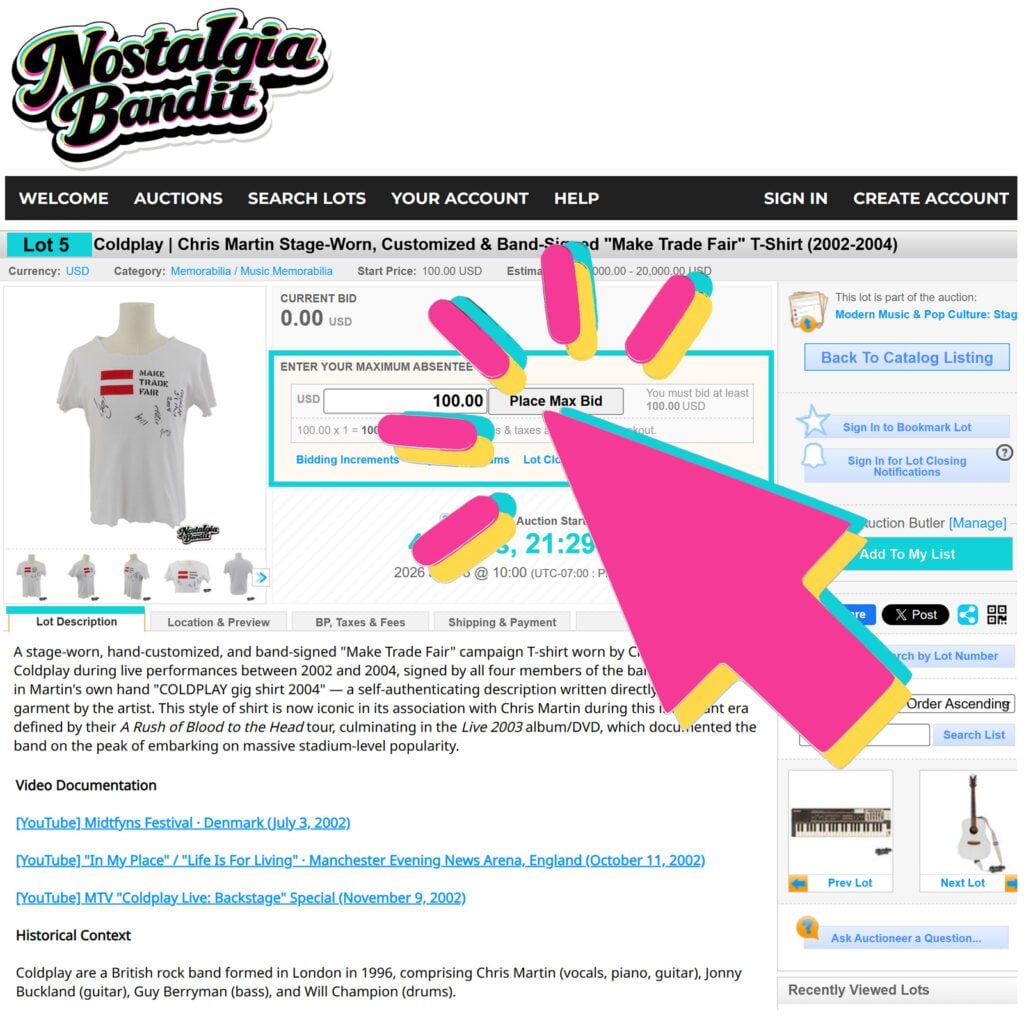
Nostalgia Bandit’s inaugural sale closes Saturday, June 13. Ninety-six lots, all music memorabilia, all researched and authenticated, all shipping with multi-page Letters of Provenance. The full catalog is here:
Future Nostalgia Bandit auctions will move through other corners of pop culture — film, television, broader categories. The inaugural sale is built around music for reasons this essay has walked through, not because the thesis stops there.
The auction is just the mechanism. The actual work is the research and work product that establishes what an artifact is, the documentation that memorializes the history and context, and the connection between the people who lived the music and the artifacts that participated in it.
If any of this resonates, you’re already part of what Nostalgia Bandit is trying to build — whether or not you ever bid on a single lot.
Anyone willing to be the next chapter can be a bandit.
Talk soon,
Jason