Screen-Matching & Photo-Matching
There is a moment, when you’re authenticating a piece, that feels like winning. You’ve got the object in front of you. You’ve got a frame from the music video, or a photograph from a magazine, or a still from the broadcast. And there — a scratch, a worn spot, a crease, a smear of paint that landed exactly where it landed… a stitch of thread — the object in your hands lines up with the object on the screen. Same mark. Same place. It’s the one. That exact one.
That moment is real, and it’s powerful, and I have spent close to twenty years chasing it. I started writing about this in 2007, on a site I ran called the Original Prop Blog. At the time, screen-matching was barely part of the conversation in the collecting world. And options for connecting with like-minded collectors were limited. Facebook was a toddler at three years old, and unless you were participating on niche stand alone forums or other groups, you were missing the discussions.
I laid out what the terms meant to me, why it mattered, and — even then — why it had to be handled with care. Over the years that followed, as DVDs gave way to Blu-ray and Blu-ray gave way to 4K, the practice got dramatically more powerful.
The collecting world has a weakness I’ve written about for almost two decades. I called it, back then, “I want to believe.” It’s the pull toward good enough — the desire, when you’re holding something you want to be real, to stop looking the moment you find a reason to say “yes” (afraid you might find a “no”). Screen-matching is catnip for that impulse. It produces a single dramatic image that feels like the end of the inquiry. A side-by-side. A match. Done.
It can be, but there is a wide spectrum of subjective interpretation.
What follows is how this actually works with me, as part of my processes — what a photo-match and a screen-match are, why a real one is so hard to realize, and how a match fits into the larger job of proving a piece is genuine.
I’ll use thirteen lots from the current Nostalgia Bandit auction as worked examples, because abstract methodology is worth less than a real object that you can look at.
The terms defined
Let’s start with the words, because they get used loosely and the looseness causes problems.
A photo-match is when you confirm that the object in hand is the same object shown in a photograph. You do it by matching physical characteristics — markings, wear patterns, hardware configuration, surface details — to the documentation. Not “the same model as.” Not “consistent with.” The same one. The guitar in your hands is the guitar in the photo, established by features specific enough that no other example could account for them.
A screen-match is the same principle applied to moving footage instead of a still — a broadcast performance, a music video, a live recording, a documentary. The logic is identical; only the source changes. You’re confirming visual correspondence between the artifact and its appearance in motion.
The distinction matters less than people think, and the overlap matters more. A video gives you both: you can pull a still frame from it and photo-match to that frame, and you can watch the object move through the footage and screen-match to the sequence.
What makes a match compelling is not the fact that it exists. It’s two things, and I laid them out the same way back in 2007:
First, the uniqueness of the identifier. A match to a generic feature proves very little. Every example of a given guitar has the same headstock logo, the same body shape, the same control layout. Matching those tells you the model, not the instrument.
A match to a unique feature — a specific scratch, an individual pattern of wear, a one-off modification, a crystal placement no other costume shares, a flame-grain in the wood that occurs in exactly one piece of maple on earth — that’s what isolates this object from every other one like it. The more unrepeatable the identifier, the stronger the match.
Second, the quality and resolution of the source. A match confirmed against a blurry, low-resolution, compressed image is weaker than a match confirmed against a sharp, high-resolution one — because the better the source, the more identifiers you can confirm, and the less you’re filling in with assumption.
Why a real match is compelling
Here is the thing that makes a genuine match so persuasive, and it’s a point I made in 2007 that I still believe is the heart of it.
When something is filmed, light does unexpected things to it. A surface that looks one way in your hands looks another way under stage lighting, through a camera lens, compressed onto video. A mark catches a highlight you wouldn’t predict. A worn edge throws a shadow that doesn’t match your intuition about how it should read. When I matched pieces in those early years, the match was usually confirmed by something I couldn’t have guessed — a detail that only made sense once I saw the object and the footage together, because no one looking at the footage alone would have reverse-engineered it correctly.
That’s the tell of a real match. It’s not that the object resembles the image seen on screen. It’s that the object explains the still or photo — including the parts of the image that were confusing until you had the object in your hand. You can’t fake the thing you didn’t know was there.
This is also why the strongest pieces of all are the ones where the object is, by its nature, the only one that ever existed.
Consider pieces in the current sale that were never mass-produced — pieces that are singular by design rather than by accident of wear.
There’s a guitar in this auction that John Gourley of Portugal. The Man hand-painted himself — a Fender Meteora covered in his own artwork. There is exactly one. When it appears in performance footage, the screen-match isn’t a question of finding a scratch that lines up. The entire surface is a unique work, and it either is or isn’t the object on screen, with no ambiguity in between. And almost as if the scenario were made for this discussion, the short film literally shows him creating the artwork on the guitar in real time.
There’s a pedalboard in this auction that Steve Stevens custom-built himself during the Billy Idol Rebel Yell era — built to his specification, a one-off piece of working equipment, every element of its configuration particular to it because he designed it from the ground up. One of one. Photographs of Stevens with his rig in that period match it because there was never a second one to confuse it with.
And there’s an original hand-painted animation frame of MCA (Adam Yauch) from the Beastie Boys’ “Shadrach” video — a single cel, painted by hand, one of the literal frames that became the finished video. No two hand-painted frames in that video are identical. The match is the frame. Even more fun is that the video that was used as reference by the artists… you can find the exact frame of MCA in the exact same pose in the “live” footage that inspired the artwork.
These pieces sit at the top of the matching hierarchy not because the match is dramatic, but because the object can’t be duplicated in the first place. You can’t manufacture a second hand-painted guitar with the same brushstrokes. You can’t reverse-engineer a one-off pedalboard from a photo or fuzzy low res screencap from the 80s. The uniqueness isn’t acquired through use and wear — it’s built in from the beginning. Those are the matches I trust the most.
The 20-year arc
The reason I keep dating things to 2007 is that I had a front-row seat to how much the ground moved.
When I started matching pieces seriously, the best widely available reference source was the DVD — standard definition, introduced in the mid-1990s, and for years the sharpest look most people could get at a frame of film or video (though some of us would also buy 35mm movie trailer clips off eBay and have them scanned). You worked with what it gave you. You could confirm a lot from a DVD, but you were also living with its limits: soft edges, compression, a resolution that hid as much as it revealed. A match against a DVD frame was a real match, but it was a match made through frosted glass.
Then the sources got better, in big steps, about a decade apart each.
Blu-ray arrived in 2006 and multiplied the available resolution several times over. Details that had been a soft suggestion on DVD became legible. Wear you couldn’t have resolved before was suddenly there to be checked. I wrote about this shift as it happened — the arrival of high-definition home video wasn’t just a nicer viewing experience, it was a new authentication instrument, one that let you confirm or reject matches that DVD simply couldn’t adjudicate.
Then in 2016, 4K Ultra HD Blu-ray arrived and quadrupled the resolution again. Now you could read individual threads in a garment, the grain in a piece of wood, the specific topography of a scuff. Footage shot decades earlier, remastered and released in 4K, started revealing things about objects that nobody — not the prop maker, not the original owner, not the studio — had ever been able to see in that footage before. I wrote about that one too, when it came, because it was obvious that the tool had taken another leap.
The catch
In 2008, writing about exactly this technology curve, I put a warning in print that I’ll paraphrase here because I think I had it right then: there are different levels of matching, and you cannot discount the possibility that a match was manufactured after the fact — especially as high-definition sources became available. Appropriate scrutiny, I wrote, must be employed. That was eighteen years ago. It’s more true now than it was then.
I want to be careful not to overcorrect here. A genuine match on a mass-produced piece, confirmed by a detail no one could have reverse-engineered, is still powerful evidence. And it certainly can be all that is needed, in some cases.
The exception — and it’s a real one — is the genuinely unique object.
When the identifier can’t be reproduced and there’s no sibling to confuse it with, a photo-match or screen-match can absolutely stand on its own. A hand-painted guitar. A road case covered in dozens of stickers whose wear and damage line up exactly. A wood grain that occurs in one piece of maple on earth. For pieces like those, the match isn’t one layer of the case — it is the case, and it’s enough. The danger isn’t matching. The danger is treating a match on a mass-produced object as though it carried the same weight as a match on a singular one.
The question, then, is what a complete case actually looks like. That’s next.
How you actually authenticate
If a match isn’t always a verdict, what is?
The honest answer is that authentication isn’t always a single thing. It’s a stack. You’re assembling independent lines of evidence that each point the same direction, and the confidence you can have is roughly a function of how many strong, independent lines you’ve got and how well they agree. Typically, no single layer carries the whole weight. The match is sometimes only one layer. Here are the others I weigh.
Chain of custody. Where has this object been, and can you trace it backward? A piece that goes straight from the artist, the tech, the wardrobe department, or the production to a documented series of owners is far stronger than one that surfaces from nowhere with a story attached. The fewer the gaps, the better. An unbroken chain back to the source is, in many ways, worth more than a dramatic match.
Letters from the principals. A signed letter of provenance from the person who would actually know — the musician, the guitar tech, the recording engineer, the executive producer of the music video, the manager who took delivery of the award — is direct testimony from someone with firsthand knowledge. Not a generic certificate from a company that never touched the item. A specific account, from a specific named person, who was there. Those are the letters that matter, and they’re the ones we pursue.
Period documentation. Photographs, invoices, receipts, shipping records, contemporaneous press, anything created at the time that places the object where it’s claimed to have been. Documentation made then is much harder to fake than testimony offered now, because it had no reason, at the time, to anticipate this question.
The cost-prohibitive test. I’ve used this one for years. Ask yourself: would the cost and effort of faking this exceed what the fake could plausibly earn? For a low-value item, elaborate forgery makes no economic sense, and that itself is a form of reassurance. For a high-value item, the opposite is true, and your scrutiny has to rise to meet the incentive. The more a genuine piece would be worth, the more skepticism it has earned the right to.
And then the match. When a match sits on top of a sound chain of custody, a credible letter from a principal, and period documentation that all agree — now the match is doing what it does best. Sometimes it’s not carrying the case. It’s confirming a case the other evidence already built. That’s the difference between a match as a verdict and a match as a tool. Same image. Completely different weight, depending on what’s underneath it.
Worked examples
What follows are thirteen pieces from the current sale, grouped by the kind of proof each one represents, explaining what the match hinges on and what’s underneath it.
The one-of-ones
These are the pieces I described earlier — singular by design, not by wear. The match is the strongest kind because the object can’t be duplicated in the first place.
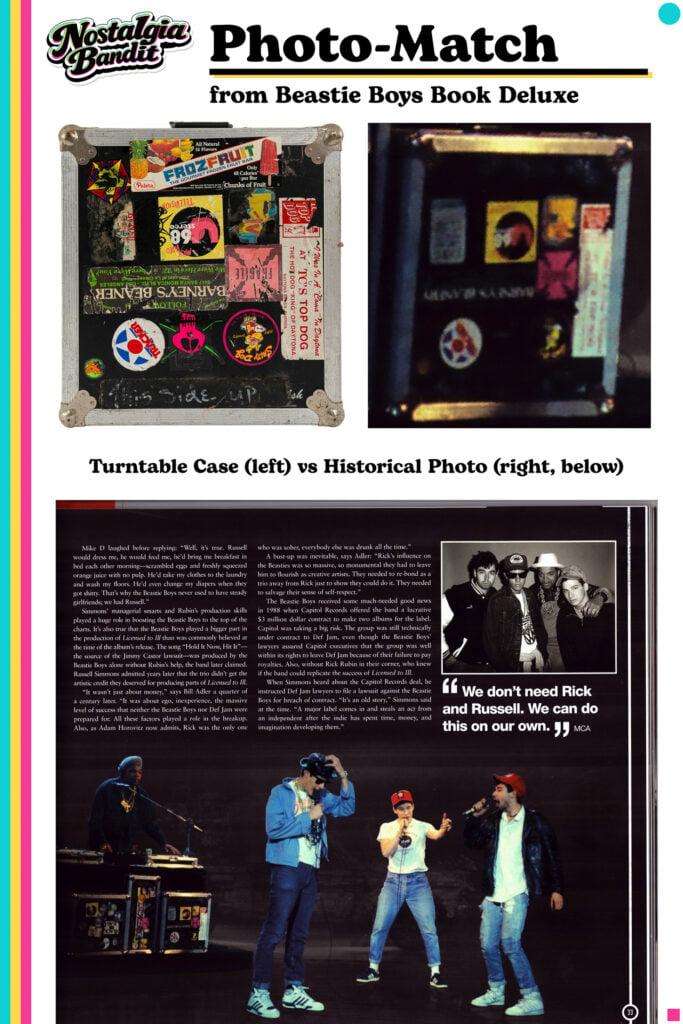
Beastie Boys — Licensed to Ill tour road case (1987). If I had to pick one piece in this sale to teach the entire method, it might be this one. The case is covered in dozens of vintage stickers, applied haphazardly over the life of the tour — and not only do their positions match the photos and footage, the wear and damage to individual stickers matches too. Better still, the case evolved: early in the Licensed to Ill tour there are fewer stickers, with more added as it went on, so the footage itself can be dated by which stickers are present. And here’s the part that defeats any attempt to fake it from a screen — in the photos and footage, most of the stickers are illegible. You can’t tell what they are. Only with the case in front of you can you resolve each one, and only then go back to the footage and confirm the blurred shapes line up exactly. You cannot reverse-engineer what you were never able to see.
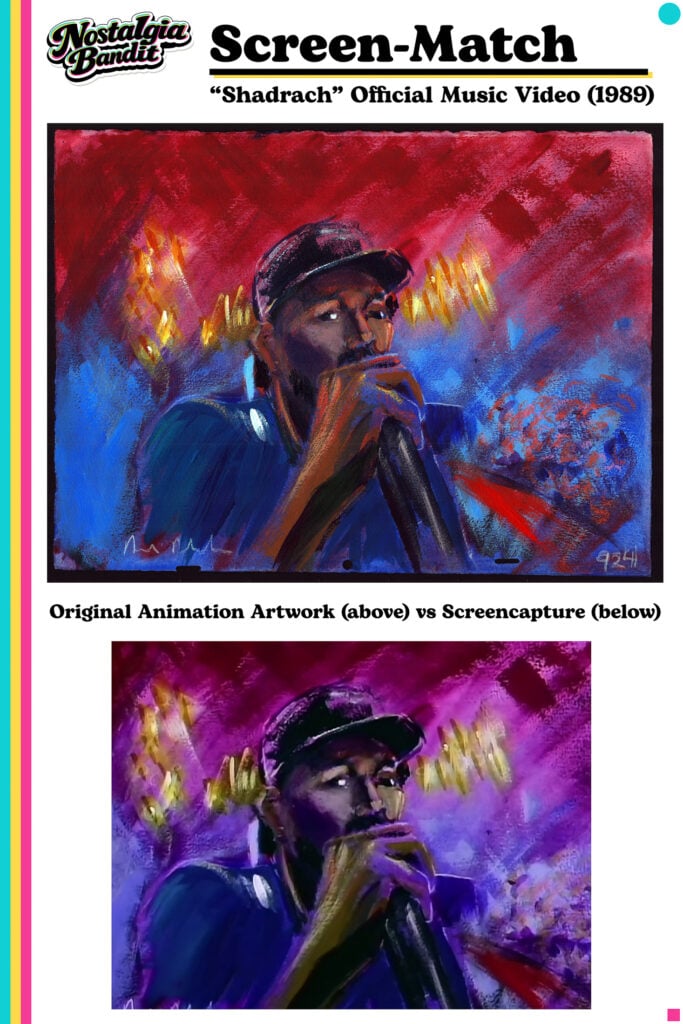
Beastie Boys — original hand-painted animation frame, “Shadrach” (1989). The “Shadrach” video was built from hundreds of frames painted by hand over the live-action footage, each one unique. This is one of those frames — an original physical artifact from the production, not a print, not a reproduction. The screen-match is absolute: this exact painted image appears in the finished video, and no second identical frame exists or could exist.
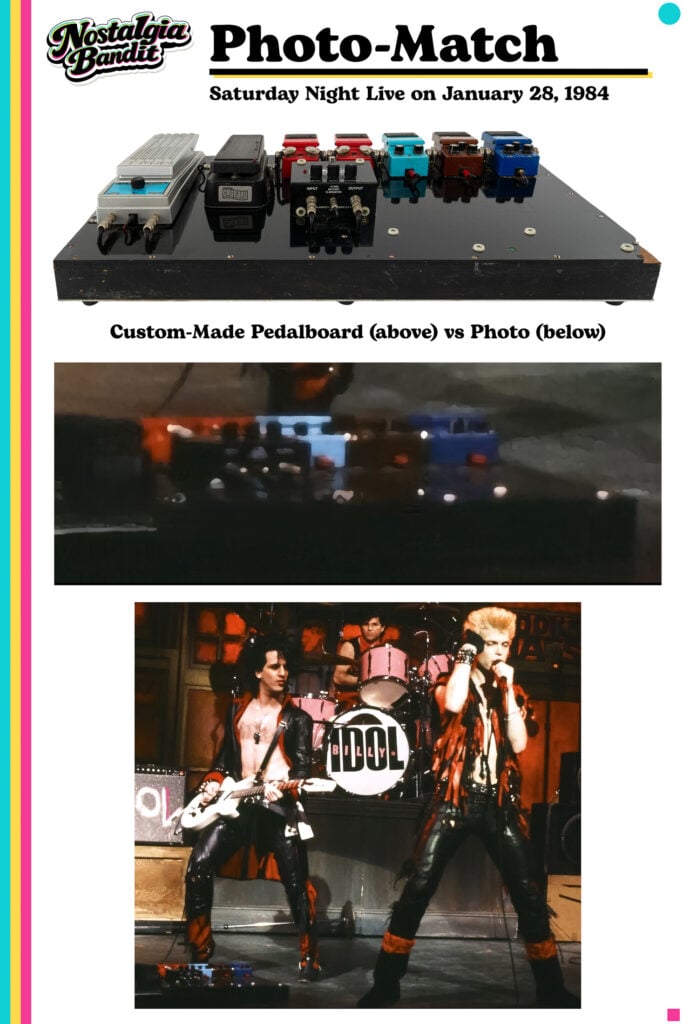
Billy Idol — Steve Stevens custom “Rebel Yell”-era pedalboard (1983–1987). Custom-built by Steve Stevens to his own specification, a one-off piece of working equipment from the era of Rebel Yell. Because there was only ever one, period photographs of Stevens’ rig match it without ambiguity. The unique components and their placement on the custom-built platform. On MTV’s New Year’s Rock N’ Roll Ball at the end of 1983. On Saturday Night Live in 1984. This also includes a letter of authenticity from Steve himself, and he’s even posted images of this piece on his social media accounts.
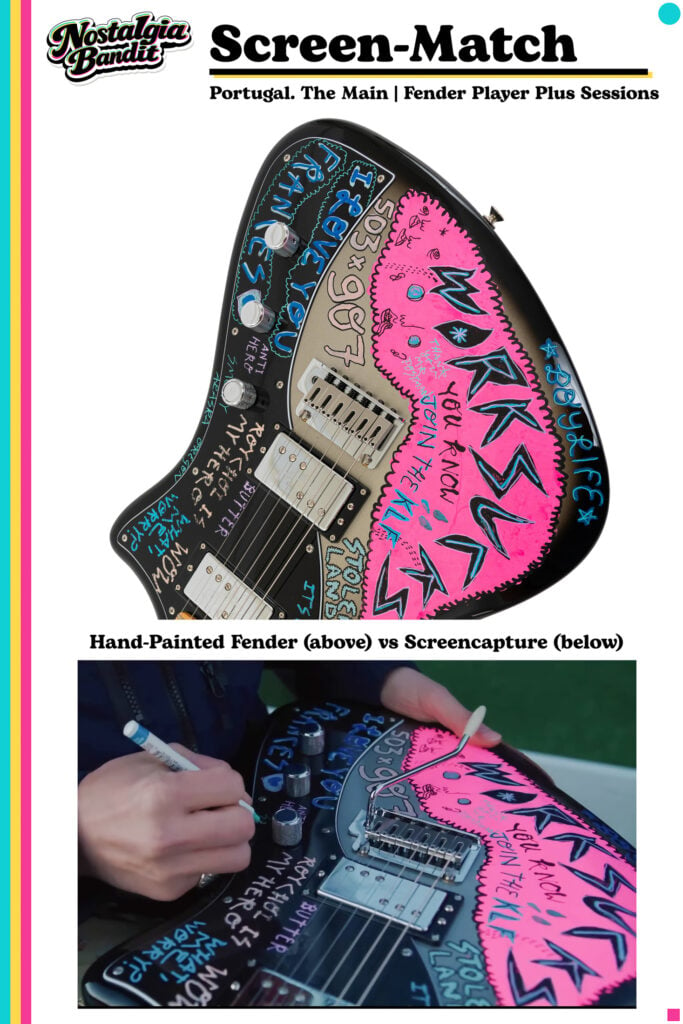
Portugal. The Man — John Gourley hand-painted Fender Meteora (2022). Gourley painted this guitar himself; the entire surface is a unique work of his own art. When it appears in performance, the screen-match isn’t about a single mark lining up — the whole instrument is the identifier. You see him create the art on screen in the short film and it came directly from the band on their official Reverb shop.
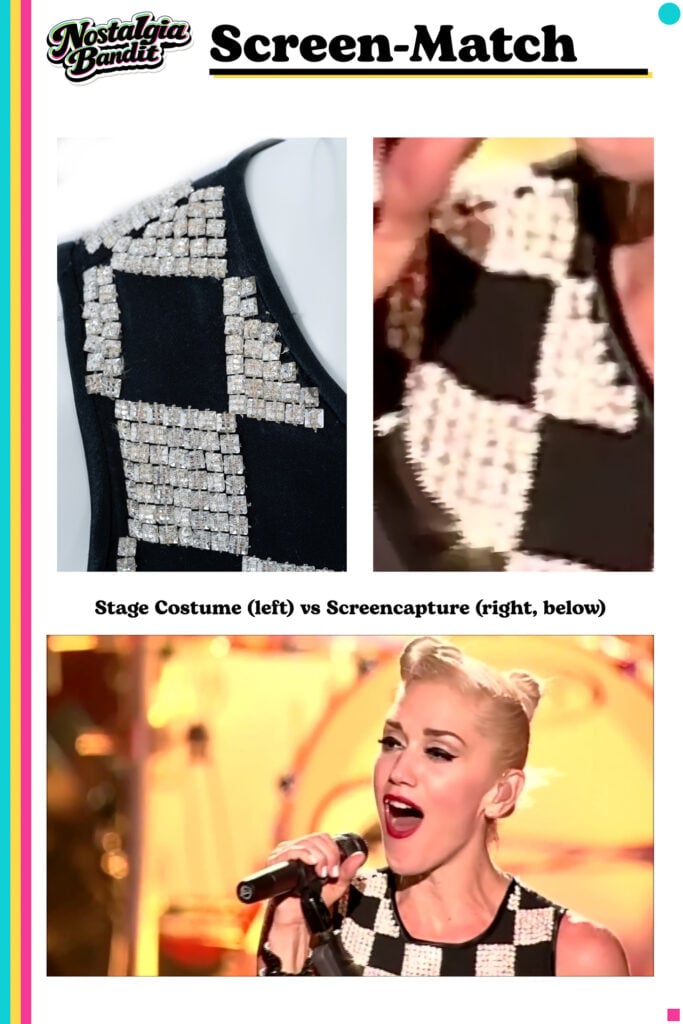
No Doubt — Gwen Stefani custom Swarovski crystal costume (2009). Custom-made for Stefani and both photo- and screen-matched. The costume pattern is made of hundreds of Swarovski square-cut crystals hand-stitched in a bold checkerboard pattern that is very unique upon close examination. Also includes a Certificate of Authenticity from Rebel Waltz Management from when it was sold by the band in a charity auction in 2010.
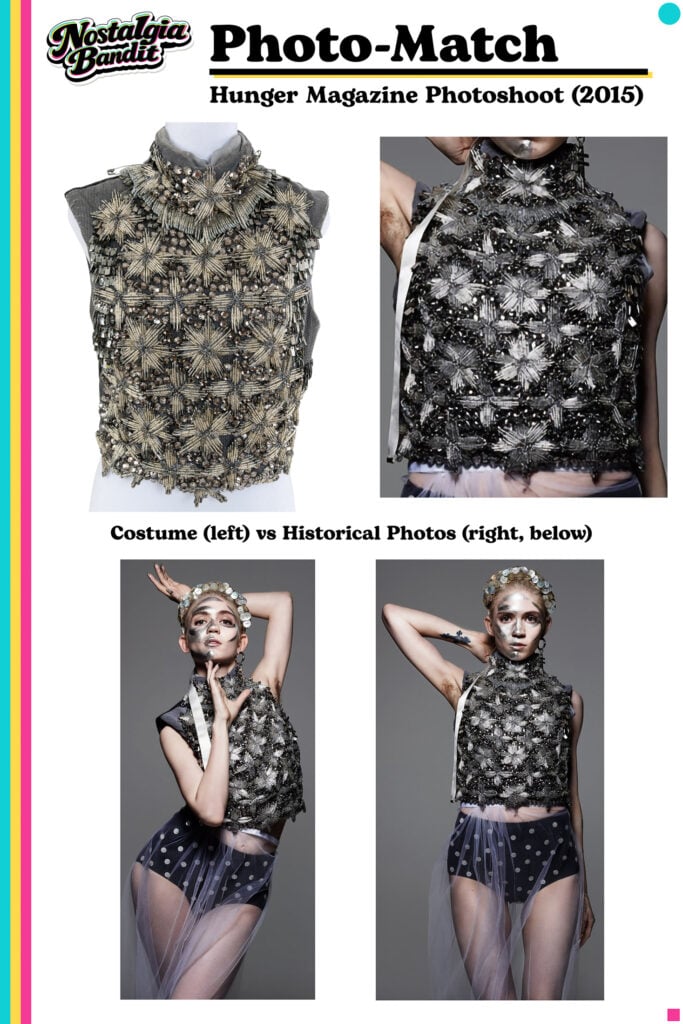
Grimes — Sorcha O’Raghallaigh custom embroidered top, Hunger Magazine (2015). Photo- and screen-matched. Similar to the Gwen Stefani piece, this one has unique hand-made embroidery made up of unique safety pins and other decorative elements placed by the designer that match the photos and videos from the Hunger Magazine photo shoot. Also includes a Letter of Authenticity from designer Sorcha O’Raghallaigh.
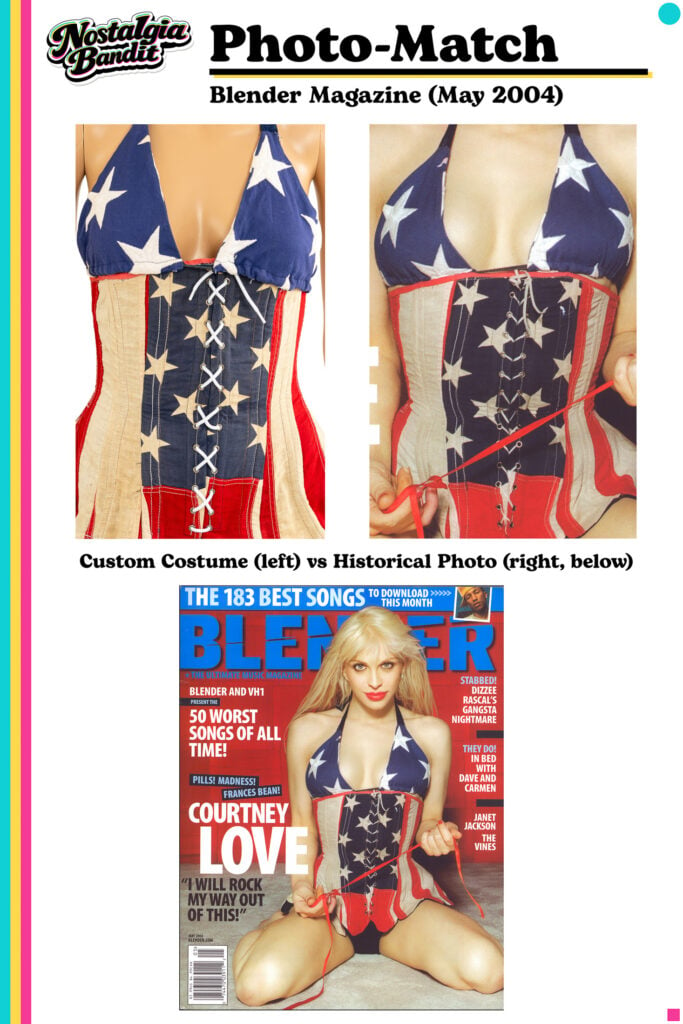
Courtney Love — American flag custom costume, Blender cover (2004). Photo-matched to the Blender magazine cover shoot. A one of one handmande costume made from an original vintage American flag redesigned into a halter bikini top and a matching American flag flouncy corset, designed and styled by Ligia Morris of Primal Stuff Entertainment, Inc. Photo-matched to the published cover and interior editorial photography. Everything on the costume matches exactly to all of the many images from the photo shoot. Every thread, every stitch; all of the distinct elements match up perfectly.
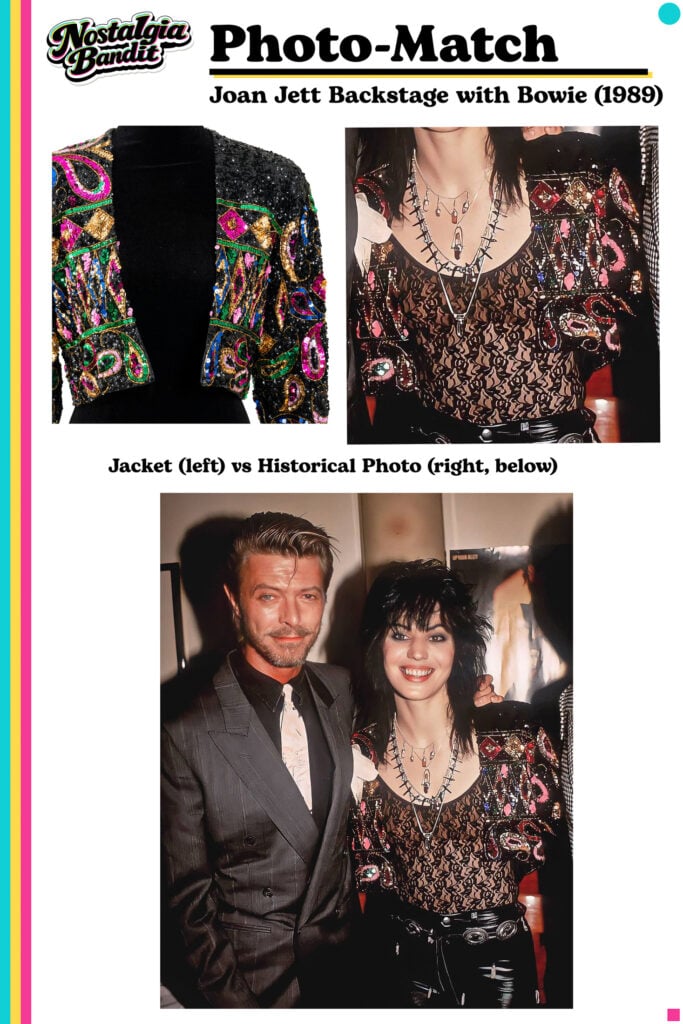
Joan Jett — custom sequined jacket, “Dirty Deeds” music video (1989–1990). Worn in the “Dirty Deeds” video and photo-matched to high resolution photos backstage with David Bowie after one of her residency shows on Broadway in 1989. Again, this is a custom jacket with very unique multicolor sequined embellishment patterns — including the distinctive gold-tone, magenta, green, blue, and black paisley and geometric motifs across the cropped silhouette. It is an exact match in all images. This was originally donated to MusiCares for a benefit auction.
The double matches
These pieces carry both a photo-match and a screen-match — usually from the same music video or shoot. Two independent confirmations from one documented appearance is far stronger than one, and as the descriptions show, most of these are unique objects in their own right, which only makes the match harder to question.
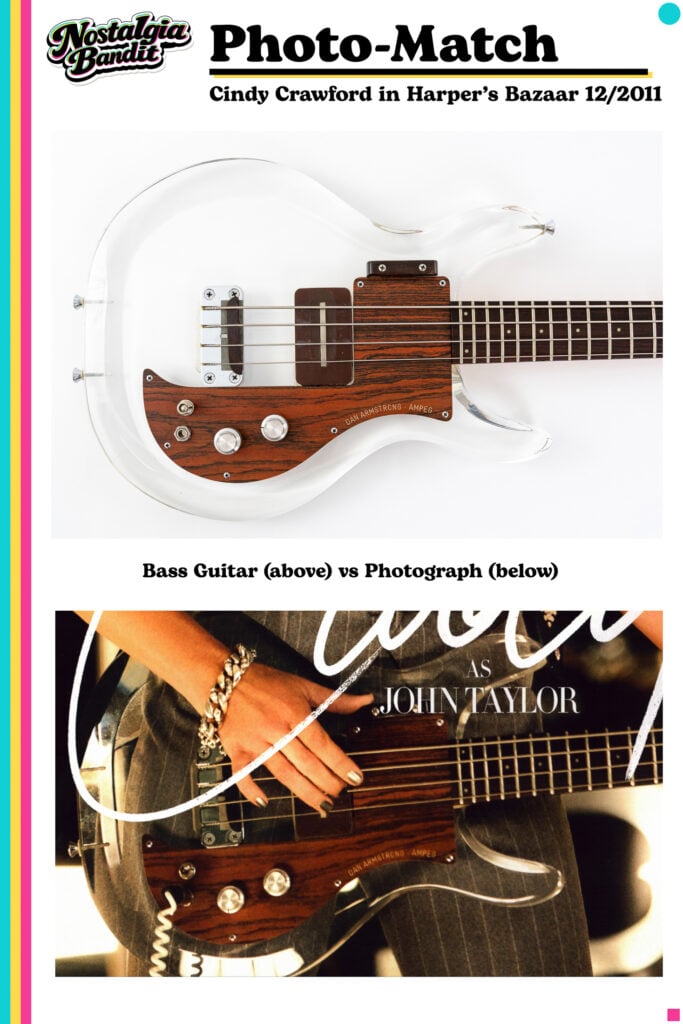
Duran Duran — “Girl Panic!” Dan Armstrong bass (2011). Used in the “Girl Panic!” video. Photo- and screen-matched. Used by John Taylor and Cindy Crawford in the music video/short film, the vintage Dan Armstrong bass guitar (circa 1970) has unique wood grain patterns in the pick guard which can clearly be matched on screen and with photography from related photo shoots during the production.
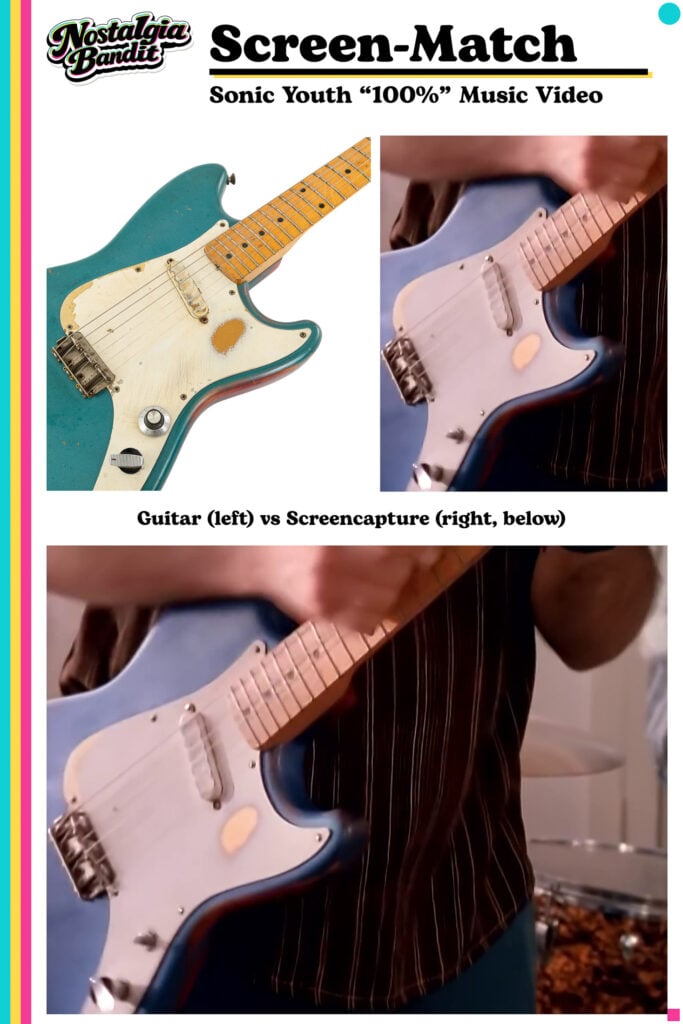
Sonic Youth — Lee Ranaldo “100%” Fender Musicmaster (1992). Used in the “100%” music video. This piece carries the rare double: it photo-matches to a production set photograph and screen-matches to the video itself. A very unique, vintage, hand painted/sprayed piece with a unique wear mark on the white pickguard showing the gold underneath. Seen in the music video and set photos taken and published in magazines.
The photo-matches
Matched to a still image — a publication, a publicity photo, a period print.
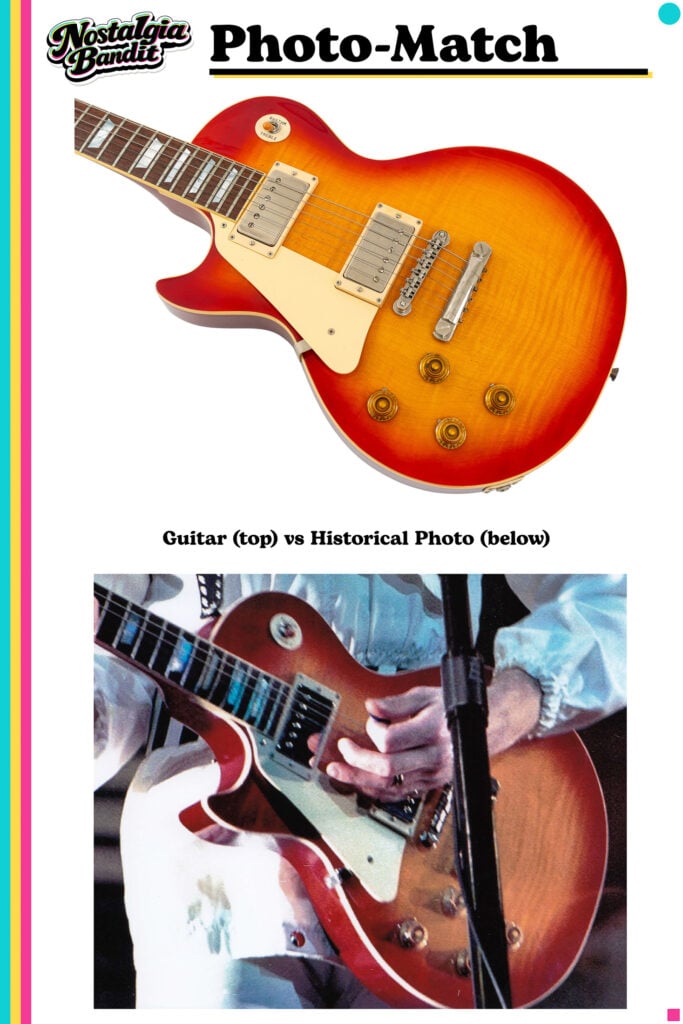
The Cars — Elliot Easton Greco EGF-1000 (1980). This one is a clean illustration of the principle. The guitar’s flame-maple top has a wood grain pattern that occurs in exactly one piece of wood — a natural fingerprint. It photo-matches to period color prints of Easton playing it, including at Madison Square Garden on December 4, 1980. It’s also one of only two left-handed examples of this model ever made, which narrows the field to almost nothing before you even get to the grain. The match here is strong precisely because the identifier — the grain — is something no one could reproduce on a sibling instrument. Also includes a Letter of Authenticity from Elliot Easton.
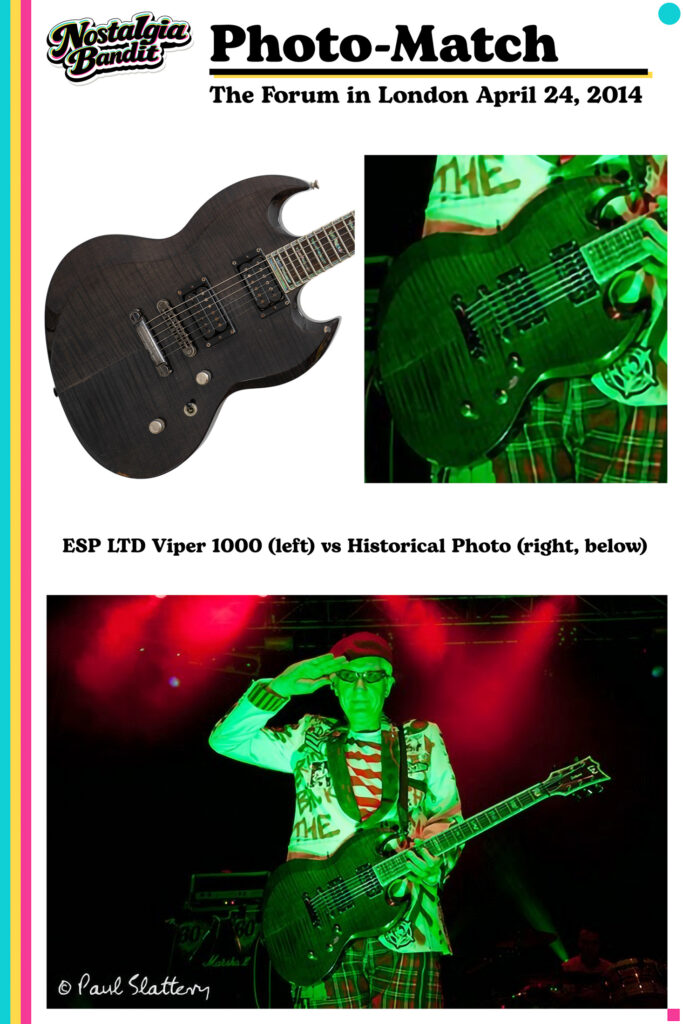
The Damned — Captain Sensible ESP LTD Viper guitar (2014). Photo-matched and signed. The guitar body is made of wood with unique grain which can be seen in still photography from Captain Sensible’s historic 60th birthday concert at The Forum, London on April 24, 2014, which is also seen playing out through the credits in the 2015 documentary film Don’t You Wish That We Were Dead, directed by Wes Orshoski. The guitar is signed on the back by three members of The Damned: Captain Sensible, Dave Vanian, and Monty Oxymoron.
The screen-match
Matched to moving footage — a performance broadcast, a filmed appearance.
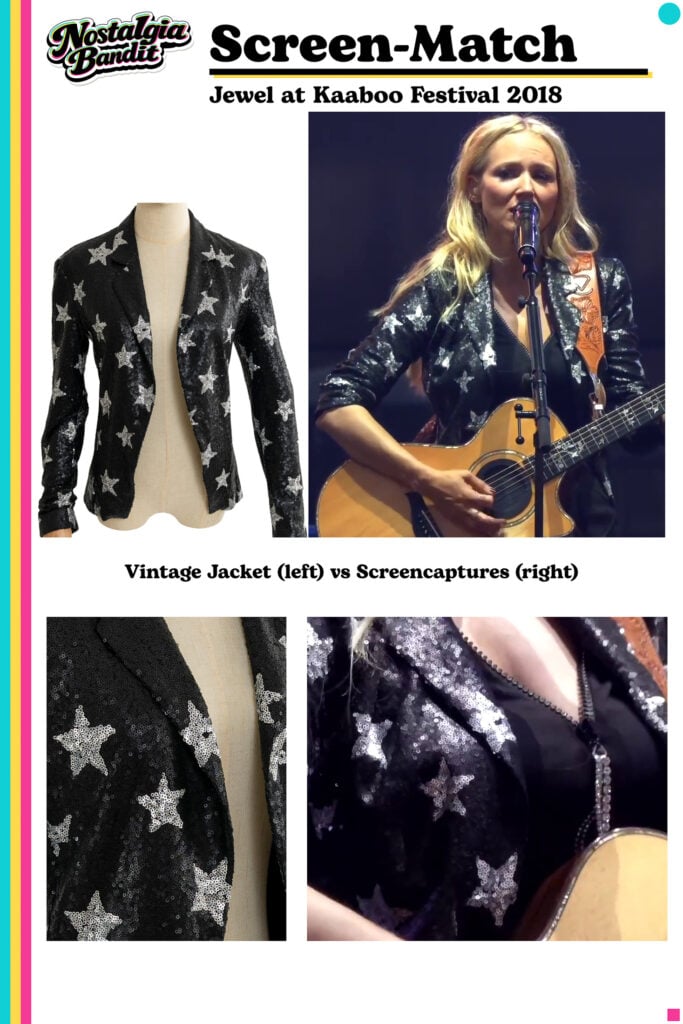
Jewel — Kalmanovich sequin jacket, Kaaboo Festival (September 16, 2018). Screen-matched to footage of her Kaaboo performance, and signed. The vintage Kalmanovich fully sequined star-pattern blazer was stage-worn by Jewel throughout the entirety of her performance at the music festival in San Diego, California on September 16, 2018, screen-matched to the professionally filmed and released full-length concert video of that performance. The placement of each unique star across the pattern of the jacket as well as unique elements, like the “hole” worn into one of the stars on her lower right lapel. This was offered for sale directly by Jewel to support the Diné Skate Garden Project on Navajo Nation. The sale was promoted by 4KINSHIP.
Close
I’ll end where I started, in 2007, because the thing I believed then is the thing I still organize my work around now.
Authentication is not a trick you perform once and file away. It’s a discipline, ongoing, and at bottom it’s a form of respect. When a piece comes through Nostalgia Bandit, the research that goes into it — the chain of custody, the letters from the people who were actually there, the period documentation, and yes, the photo-matches and screen-matches where they apply — isn’t there to dress the object up. It’s there because the object deserves to be understood for exactly what it is, no more and no less. Overclaiming dishonors a piece as surely as ignoring it does.
The pieces in this auction were used by the people who made the music and the images that shaped a generation. They earned their histories honestly. The least I can do is document them the same way.